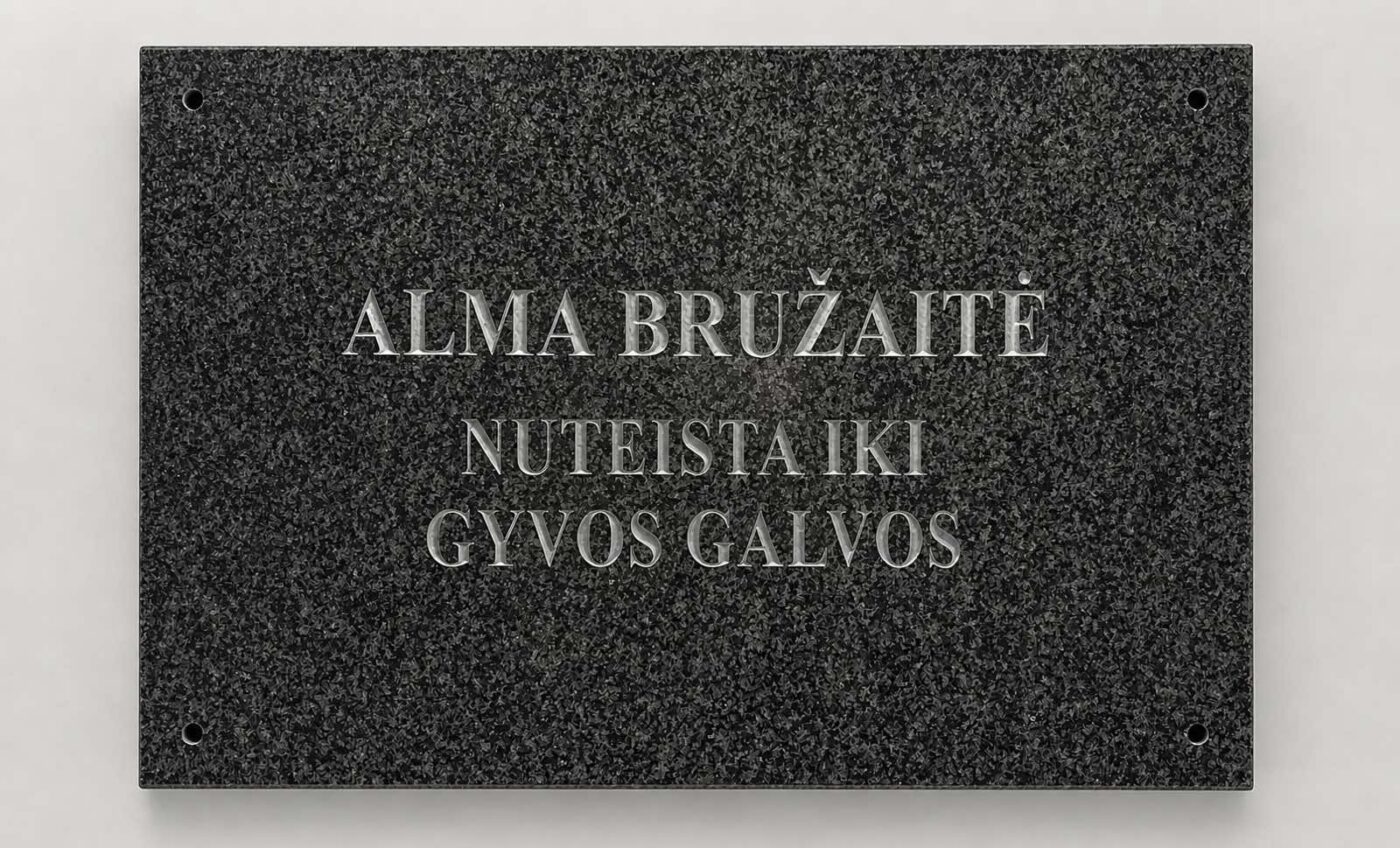
The work began with the problem of symbolic inscription.
Alma Bružaitė was sentenced to life imprisonment for killing her two children. In the public imagination she has been repeatedly fixed through available signifiers – murderer, child-killer, monstrous mother – yet none of them seemed capable of fully absorbing the disturbance produced by her radical violation of the maternal injunction, unsettling motherhood as a fundamental cultural and political topos through which femininity is organized. The work approached Bružaitė not as someone existing outside the symbolic order, but as a figure through whom its insufficiency becomes unusually visible: something remains after identification, judgment and explanation have done their work.
The memorial plaque was chosen precisely because it appears to promise the opposite. Memorial form is an institutional technology of symbolic inscription. It identifies, localizes and stabilizes a subject within collective memory; it transforms a life into a legible historical figure.
The initial proposition of the work therefore depended on a contradiction. A form designed to stabilize memory was given a figure whose symbolic position resists such stabilization. The plaque was intended to expose the failure of this encounter: the impossibility of making the individual coincide completely with the signifiers assigned to her.
After the exhibition opened, this proposition became less secure.
A visitor to the exhibition, a prosecutor who said he had participated in the criminal proceedings against Bružaitė, looked at the plaque and remarked that they had imprisoned her and that he would gladly imprison her many times again. He photographed the work and sent it to his colleagues. What disturbed me was not simply the punitive satisfaction of his response. It was how little resistance the object seemed to offer it.
For him, there appeared to be no contradiction at all.
ALMA BRUŽAITĖ
SENTENCED TO LIFE IMPRISONMENT
The memorial did not necessarily destabilize the sentence. It could monumentalize it.
At that point Kafka’s In the Penal Colony became difficult to avoid. Kafka’s Officer is not merely a sadist. He is a believer in the apparatus. He believes in the machine, in the sentence, in punishment as a producer of truth. Justice does not precede the apparatus and authorize it; the apparatus itself produces what counts as justice.
The prosecutor’s response suggested an equally uncomfortable possibility. Perhaps he did not misunderstand the work. Perhaps the apparatus recognized its own language.
There is no biography on the plaque, no psychological explanation, no social history, no counter-narrative. There is a name and a juridical sentence. What I had conceived as a collision between an unstable figure and a stabilizing memorial form could therefore operate in reverse: the memorial might conceal the very excess it was intended to expose by allowing the individual to coincide, apparently without remainder, with the sentence imposed upon her.
In this sense, the work may have exhibited not the failure of representation but its efficiency – the capacity of symbolic order to cover over the gap between individual and subject by declaring the identification complete.
Yet this does not exhaust the object either.
It remains a memorial plaque for Alma Bružaitė.
A memorial is not only an apparatus of classification. It is also an institution that produces legitimate memory. To dedicate a memorial to Bružaitė is therefore to refuse the simpler operation by which punishment becomes the final social relation to an individual: spectacle, sentence, exclusion, archive, oblivion. Even while the inscription threatens to reduce Bružaitė to the verdict, the memorial form insists that she remains within a relation to collective memory.
The work is therefore caught between two incompatible movements.
It returns a condemned individual to memory.
And it risks reproducing the apparatus that reduced her to a sentence.
What initially appeared to me as a critique of symbolic inscription now seems less secure and more disturbing. The object does not stand safely outside the mechanism it interrogates. It may expose the impossibility of complete symbolic identification; it may just as easily demonstrate how efficiently that impossibility can be concealed.
Perhaps the darkest possibility is not that the work failed to resist the apparatus.
It is that the apparatus recognized itself in the work before its author did.